
How Our Rockets Come Back To Earth
Launch gets the attention, but recovery is what makes a real launch business possible. At Sunburnt Space, bringing rockets and payloads is the foundation that enables reuse, cadence, and learning from every flight.
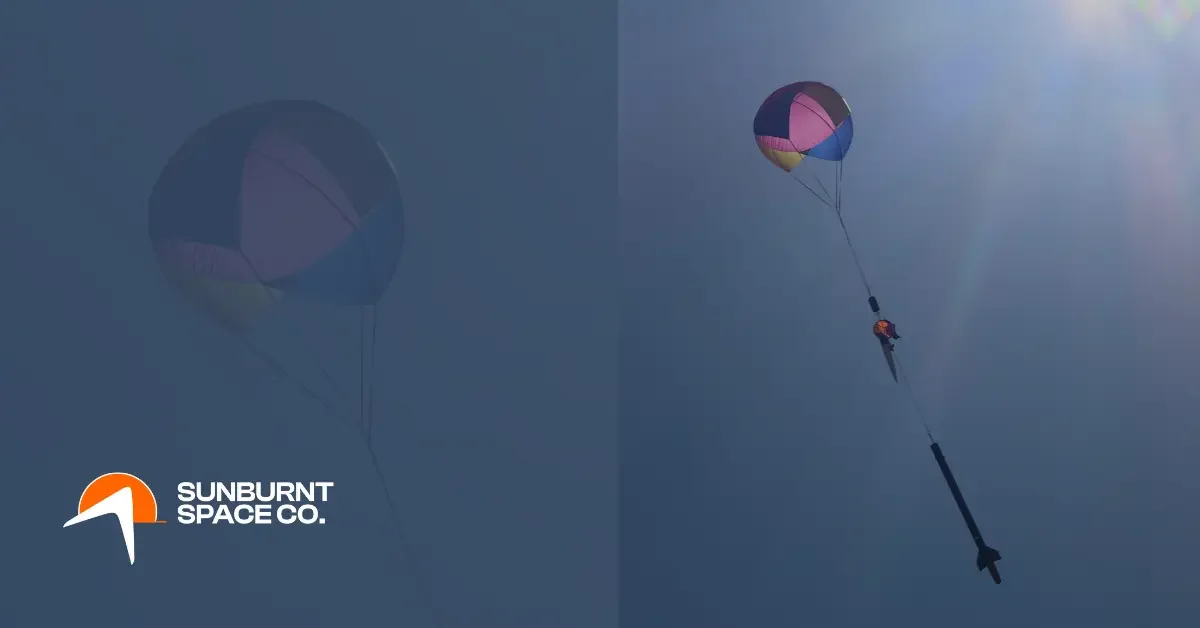
How Our Rockets Come Back To Earth
When most people think about rockets, they think about launch.
Fire. Noise. Acceleration. The dramatic bit.
But if you’re building a real launch business, launch is only half the story. What matters just as much—sometimes more—is what happens after the engine shuts off.
For us at Sunburnt Space, recovery can’t be an afterthought. It’s the foundation that makes everything else possible. We are selling payload delivery. We must be able to recover.
A Suborbital Flight Has Four Distinct Phases
A typical Mini Meggs flight looks like this:
Powered Ascent
The engine burns for tens of seconds, accelerating the rocket upward through the atmosphere.Coast Phase (Microgravity)
After engine cutoff, the rocket follows a ballistic trajectory.
This is where microgravity happens — not because we’re in orbit, but because everything inside the vehicle is in free-fall.Descent
Gravity wins, the vehicle falls back toward Earth, re-entering denser atmosphere.Recovery
Parachutes deploy, the vehicle slows dramatically, and we bring the rocket (and payloads) back intact.
Each phase has its own challenges. But recovery is where good plans meet messy reality.
(Watch this video to see all the phases in action – https://youtube.com/shorts/CE_lYvzLvIw)
Why Recovery Is Harder Than It Looks
From the outside, parachutes seem simple. From the inside, they are one of the most failure-sensitive systems on the vehicle.
Recovery has to work across:
Wide altitude ranges
Large changes in air density
High descent speeds
Variable winds
Shock loads at deployment
Rough terrain at landing
And it has to work every time, because customers want their hardware back. Not just their data.
A parachute that deploys:
Too early → excessive loads
Too late → excessive speed
At the wrong attitude → entanglement risk
There’s very little margin for “close enough”.
Why We Chose Parachute Recovery
At our scale and flight profile, parachute recovery is the most reliable and well-understood option.
It gives us:
Predictable descent rates
Gentle landing conditions for payloads
Full vehicle recovery
Fast turnaround between flights
More complex recovery systems exist, but complexity is not your friend when your goal is simplicity and repeatability
In 2026, we care far more about:
Consistent recovery
Payload survivability
Learning from every flight
Than chasing exotic solutions before the basics are nailed.
Recovery Is What Enables Reuse
Across the industry it feels like Reuse is a buzzword. Not for us. Fo us it’s a requirement. Our unit economics rely heavily on reusability and it’s at the core of what we are developing.
Every recovered rocket gives us:
Real-world data on loads, wear, and fatigue
Confidence in refurbishment assumptions
Lower cost per flight
The ability to fly more often without rebuilding from scratch
Without reliable recovery, cadence collapses.
Without cadence, costs rise.
Without costs under control, the business doesn’t work.
Recovery is what turns launches from events into operations.
Who Cares? It’s just Recovery Right?
For our customers, recovery matters just as much as microgravity time.
Recovered payloads allow:
Post-flight inspection
High-fidelity data extraction
Validation of hardware survival
Rapid iteration for the next flight
In many cases, the learning happens after landing, not during the flight itself.
That’s why we design recovery with payloads in mind and not just the rocket.
The Big Picture
Anyone can build something that flies once.
Building something that:
Flies
Comes back
Is inspected
Is flown again
On a predictable schedule
now that’s the real challenge. And that’s what we’re focused on.
Want to Follow Along?
If you’re interested in how suborbital spaceflight actually works. The practical details, the trade-offs, and the lessons learned. We share regular updates as we build and fly.
Enter your details below and have our regular updates delivered straight to your inbox.
(Behind-the-scenes progress, flight insights, and lessons from building a launch business in Australia.)
Get our regular updates
Launches, milestones, and the engineering notes behind them. Straight to your inbox.
← All articles