
Why We Chose Liquid Engines and Why It Matters for the Future of Microgravity Research
We chose liquid engines from day one because they offer the control, predictability, and gentle flight conditions required for high-quality microgravity research. While solids and hybrids come with major limitations, liquids unlock throttleable, reusable, scalable propulsion. All essential for flying sensitive payloads and building toward orbital capability.
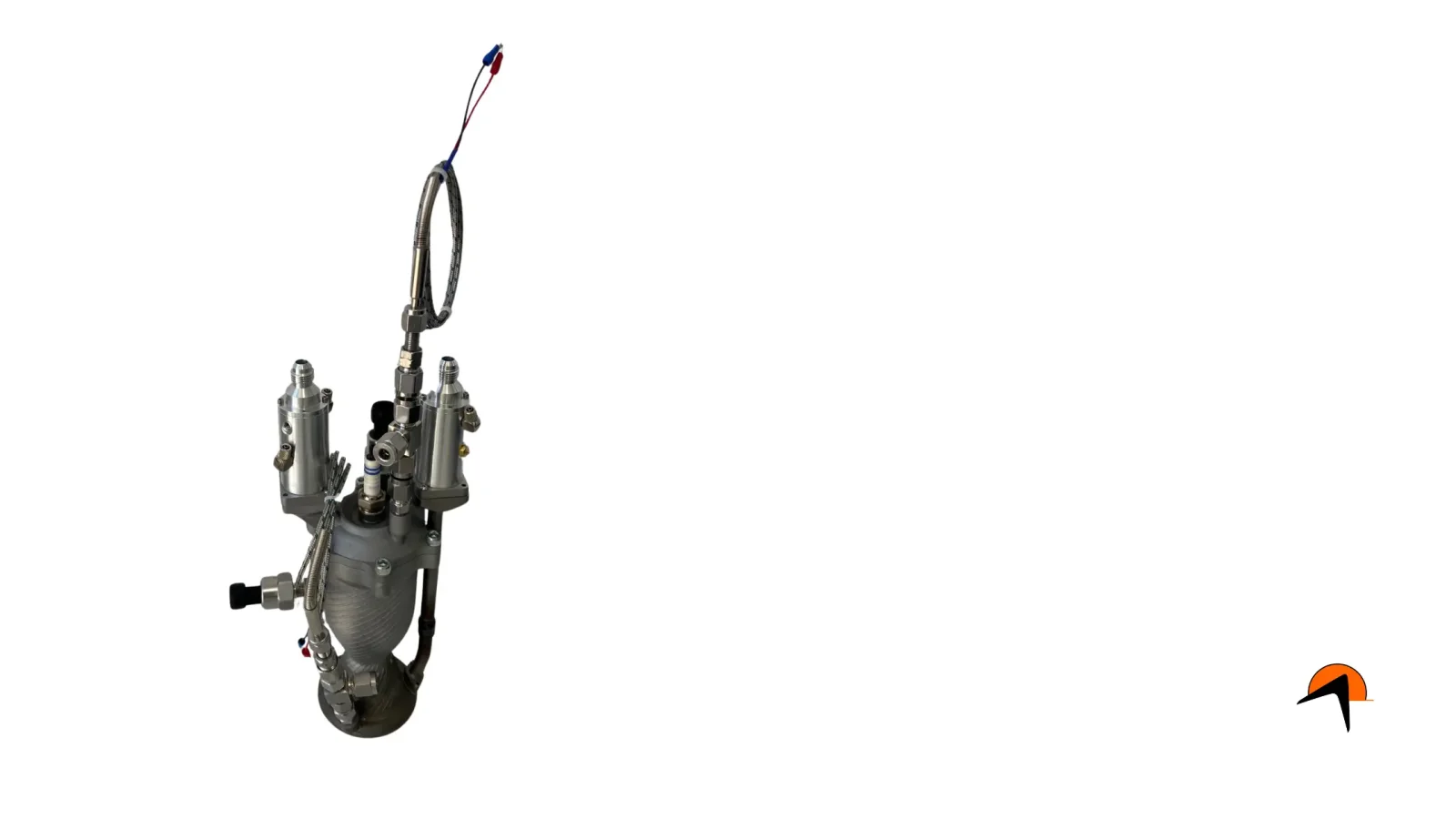
Why We Chose Liquid Engines — and Why It Matters for the Future of Microgravity Research
When we started Sunburnt Space Co, we had a decision to make: which propulsion system would define our entire launch architecture? After decades of building rockets across all major engine types—solid, hybrid, and liquid—we chose the path that gives researchers the best flight environment and gives us the clearest route to orbit: liquid engines.
Why Hybrids Don’t Scale Well
Hybrids seem attractive at first: simple plumbing, relatively safe propellants, and quick turnaround between static tests.
But in practice, hybrids are incredibly difficult to scale with precision. Their burn profile is dependent on grain geometry, port regression, and oxidiser flow dynamics, variables that shift from one burn to the next. This makes it hard to achieve predictable performance, consistent thrust, and stable microgravity profiles for research-grade missions.
If you’re trying to build a commercial service where customers rely on repeatable flight conditions, hybrids introduce too much variability.
Why Solids Are Too Aggressive, and Too Expensive
Solid rockets are powerful, but that power comes at a cost. Their thrust curve is fixed the moment the grain is cast. You can’t throttle them. You can’t shut them down. And they produce extremely high initial acceleration. Far above what many research payloads can tolerate.
This makes solids unsuitable for delicate experiments like biological samples, pharmacology payloads, and early-stage hardware tests.
They’re also surprisingly expensive at scale. Every grain is single-use, and high-energy solids trigger export controls long before you even get your rocket on the pad.
Why Liquids Are the Clear Winner
Liquids are harder. They demand precision in plumbing, control systems, ignition, and thermal management.
But the payoff is enormous:
Throttleability — allowing gentle ascent, smoother microgravity transitions, and powered recovery.
Predictability — consistent thrust curves, controllable burn times, and refined flight profiles.
Scalability — once your engine cycle is validated, growing from suborbital to orbital becomes a matter of scaling tanks, pumps, and chambers.
Reusability — liquids can be restarted, re-flown, and maintained like real infrastructure, not disposable pyrotechnics.
This is why every modern launch leader—SpaceX, Rocket Lab, Relativity, Astra, ABL—uses liquid engines. If you’re serious about building a launch company with real cadence and real commercial value, you start with liquids.
Yes, they’re tough. Yes, they take more engineering. But they give you the one thing every launch service needs: control.
Why This Matters for Microgravity Customers
The choice of propulsion is more than an engineering debate. It directly affects the scientists, innovators, and hardware teams flying with us.
Liquid engines give us:
lower ascent acceleration
smoother staging
controlled coast phases
cleaner shutdown for microgravity entry
precise guidance for recovery
This is especially important for biological payloads, where sudden shocks or high-G events can destroy samples, kill cell cultures, or invalidate experimental data. Liquids allow us to create gentle flight conditions, giving bioresearchers a safe, predictable environment that hybrid or solid engines simply can’t match.
For universities, biotech labs, and pharma teams experimenting with crystallisation, tissue responses, or microbial studies, this difference is everything. A controllable engine is mission assurance.
Choosing Liquids Was a Hard Decision, But the Right One
Most new launch companies try to “walk before they run” with solids or hybrids.
But the truth is: if you intend to scale, to serve customers, and to reach orbit, you eventually have to move to liquids.
We chose to start where others end.
And because of that, we now have a flight-proven launch system, a bi-propellant engine ready for commercial missions, and a clear roadmap that takes us from short microgravity flights to 30-minute missions and, ultimately, orbital payload delivery.
Get our regular updates
Launches, milestones, and the engineering notes behind them. Straight to your inbox.
← All articles