
Why Fluids Are Weird in Microgravity
In microgravity, fluids stop behaving the way we expect because gravity is no longer the dominant force. Suborbital microgravity reveals how surface tension, capillary forces, and pressure gradients take over, often exposing behaviours that never appear in a lab.
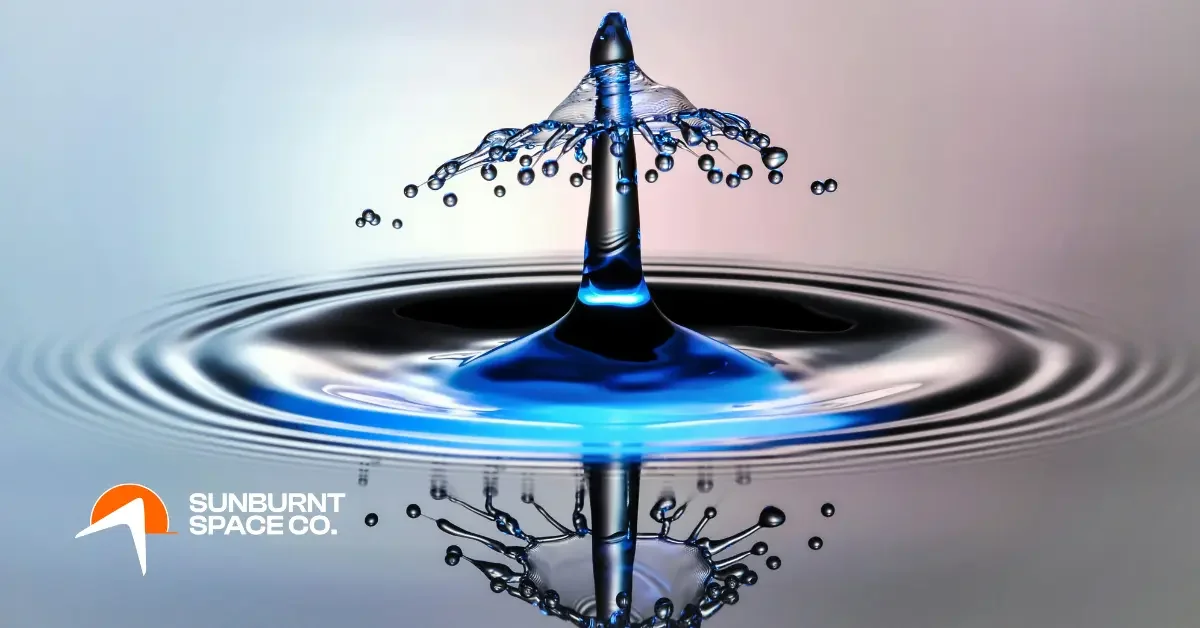
Why Fluids Are Weird in Microgravity
If you’ve ever watched footage from space, you’ve probably seen it.
- Water forming floating spheres.
- Liquids crawling along surfaces.
- Droplets refusing to behave.
It looks strange, almost playful. But for engineers and researchers, it’s incredibly important.
Fluid behaviour changes dramatically in microgravity, and understanding those changes is one of the biggest reasons teams fly suborbital missions.
Gravity Does More Than You Think
On Earth, gravity quietly does a lot of work for us.
It:
- Pulls fluids “down”
- Drives settling and separation
- Shapes how liquids flow through pipes and containers
- Masks smaller forces acting on the fluid
Because gravity is always present, many fluid behaviours feel predictable. We design around them without even thinking about it.
Remove gravity, and suddenly, all those assumptions fall apart.
What Changes in Microgravity?
In microgravity, gravity is no longer the dominant force acting on a fluid.
Instead, other forces take over.
Surface Tension Becomes King
On Earth, surface tension is usually overwhelmed by gravity.
In microgravity, it dominates.
That’s why liquids form spheres, cling to surfaces, and move in ways that feel counterintuitive.
Fluids Don’t “Settle”
There’s no up or down in the usual sense.
Heavier components don’t sink.
Lighter components don’t rise.
Sedimentation and buoyancy-driven flows disappear.
This has major implications for:
- Mixing
- Separation
- Chemical reactions
- Biological systems
Flow Is Driven Differently
Without gravity, fluids move due to:
- Pressure gradients
- Capillary forces
- Thermal effects
- Vehicle motion or vibration
This can completely change how pumps, valves, and channels behave.
Why Lab Testing Can Be Misleading
In a lab, fluids always experience gravity.
You can tilt experiments.
You can rotate them.
You can simulate aspects of microgravity.
But you can’t remove gravity from the equation.
That means some behaviours simply won’t appear until the system is in free-fall — which is why teams often discover surprises during flight.
Suborbital microgravity allows teams to see these effects early, before committing to long-duration orbital missions.
What Teams Test in Suborbital Microgravity
Suborbital microgravity is particularly useful for fluid-related experiments, including:
- Fluid mixing and separation
- Capillary-driven flow
- Crystallisation and material formation
- Microfluidics and lab-on-chip systems
- Biological samples suspended in fluid
- Fuel and propellant behaviour
- Thermal-fluid interactions
Because payloads are recovered, teams can combine in-flight data with post-flight inspection and analysis.
Why the Coasting Phase Matters
On a suborbital rocket flight, fluids experience microgravity during the coasting phase, after engine cutoff.
This phase is:
- Clean and low disturbance
- Predictable in timing
- Long enough (minutes) for meaningful observation
That makes it ideal for fluid experiments that need a stable microgravity window.
Why This Matters Beyond Research
Fluid behaviour affects more than experiments.
It impacts:
- Life-support systems
- Fuel management
- Thermal control
- Manufacturing processes
- Biological and pharmaceutical research
Many space systems fail or underperform not because of electronics or structures, but because fluids don’t behave the way designers expected once gravity is removed.
Finding that out early matters.
The Bigger Picture
Microgravity doesn’t make fluids “weird”, it reveals how much gravity was doing for us all along.
Suborbital microgravity gives teams a practical way to observe, measure, and understand fluid behaviour in free-fall, without the cost or timelines of orbit.
That’s why fluid experiments remain one of the most common — and most valuable — uses of suborbital microgravity.
Want to Follow Along?
If you’re interested in how teams use suborbital microgravity to study fluids, materials, and biological systems, we share regular updates as we build and fly.
Enter your details below to join our regular updates email list.
(Behind-the-scenes progress, flight insights, and lessons from building a launch business in Australia.)
Get our regular updates
Launches, milestones, and the engineering notes behind them. Straight to your inbox.
← All articles