
Suborbital Microgravity: How It Works, When It Happens, and Who It’s For
Suborbital microgravity doesn’t require orbit like most think. On a rocket, It occurs during the coasting phase, after engine cutoff, when the vehicle and payloads arc over apogee. This window enables real microgravity research, hardware testing, and rapid validation without the cost or timelines of orbital missions.
Suborbital Microgravity
How It Works, When It Happens, and Who It’s For
Microgravity is one of those terms that gets used a lot and misunderstood even more.
Most people assume you need to be in orbit to experience it. Others think it’s something abstract or only relevant to astronauts.
In reality, suborbital microgravity is experienced during a very specific part of a rocket flight: the coasting phase, after engine cutoff. And it’s this phase that enables the research, testing, and validation work we’re building around at Sunburnt Space.
What Is Suborbital Microgravity?
First, an important clarification: Microgravity does not mean zero gravity.
Gravity is still acting on the vehicle at all times. What changes is whether there are other forces acting on it.
Microgravity occurs when gravity is the dominant force and there is no sustained thrust or support force acting through the structure. This is exactly what happens during the coasting phase of a suborbital rocket flight.
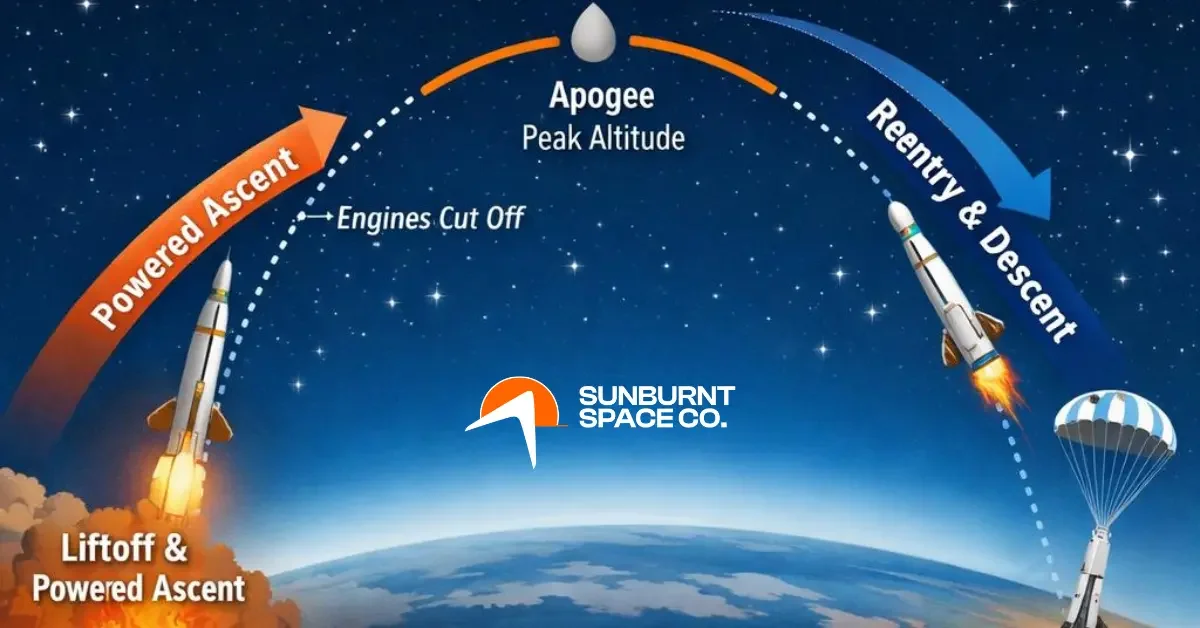
Heres a diagram showing all the parts of a rocket flight so you can get a good visual idea.

How a Suborbital Flight Creates Microgravity
A suborbital rocket flight has four main phases:
Powered Ascent
The engine fires, accelerating the rocket upward through the atmosphere. During this phase, the vehicle experiences acceleration forces.
Engine Cutoff
Once the engine shuts down, thrust stops completely.
Coast Phase (Suborbital Microgravity)
After cutoff, the rocket follows a ballistic arc. The vehicle, payloads, and experiments are all in free-fall together after they reach apogee. This coast phase is where suborbital microgravity occurs.
It’s typically:
Clean
Predictable
Low disturbance
Well suited for experiments and hardware testing
Descent & Recovery
Eventually, gravity brings the vehicle back down, recovery systems deploy, and the rocket is returned to Earth.
When Does Suborbital Microgravity Happen?
A common misconception is that microgravity starts at launch. It doesn’t.
Suborbital microgravity begins only after the engine shuts off and continues until aerodynamic forces start to dominate again during descent.
The duration depends on:
Altitude reached
Flight profile
Vehicle performance
Depending on the mission, this can range from tens of seconds to several minutes of continuous microgravity — more than enough time for many meaningful experiments and validation activities.
What Makes Suborbital Microgravity Useful?
Suborbital microgravity sits in a powerful middle ground.
It offers:
Real microgravity conditions
Short timelines (weeks or months, not years)
Full payload recovery
The ability to fly, learn, and fly again
Unlike parabolic flights, it provides sustained microgravity. Unlike orbital missions, it doesn’t come with multi-year waits and massive cost.
That combination is what makes suborbital microgravity so valuable.
Who Can Benefit From Suborbital Microgravity?
Suborbital microgravity is underutilised. We are seeing it become a stronger early testing ground for space tech hardware and researchs. Instead of waitiing years and spending millions, flying suborbital will get you testing a lot faster, with high cadence for a much lower budget.
Here’s a few teams that would benefit most include:
Space Hardware Teams
Sensor calibration
Mechanisms and deployables
Avionics validation
Subsystem integration testing
Bio, Pharma & Materials Researchers
Fluid behaviour in microgravity
Crystallisation experiments
Biological response studies
Materials formation and mixing
Universities & Student Teams
Real flight heritage
Hands-on spaceflight experience
Publishable data
Progression beyond lab-only work
Early-Stage Startups
Advancing Technology Readiness Level (TRL)
Generating real flight data
Supporting grant applications
De-risking before committing to orbit
For many teams, suborbital microgravity is the fastest way to move from theory to evidence.
The Bigger Picture
Suborbital microgravity isn’t a novelty or a stepping stone to ignore. It’s a practical, repeatable tool that fills the gap between the lab bench and orbit. And it’s the foundation of what we’re building at Sunburnt Space.
Want to Follow Along?
If you’re interested in how suborbital microgravity actually works—the practical details, real flight profiles, and how teams use it in the real world—we share regular updates as we build and fly.
Enter your details below to join our regular updates email list.
(Behind-the-scenes progress, flight insights, and lessons from building a launch business in Australia.)
Get our regular updates
Launches, milestones, and the engineering notes behind them — straight to your inbox.
← All articles